In the fast-moving world of paid media, time is money. Marketers juggle dozens of keywords, ad variations, bidding strategies, and budget allocations across multiple platforms. The right insight at the right moment can mean the difference between wasted spend and a highly efficient, high-performing campaign.
AI-powered PPC reports promise to turn raw data into actionable intelligence with speed and precision. This article explains what AI-powered PPC reports are, why they matter, how to implement them effectively, and best practices to maximize your return on ad spend (ROAS).
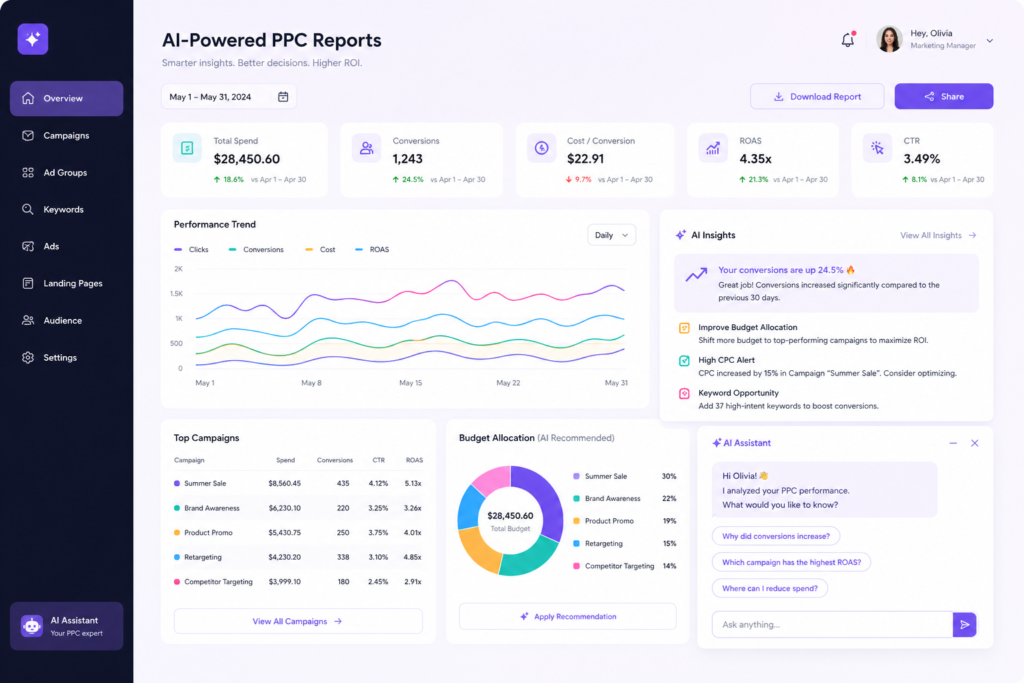
What they are: AI-powered PPC reports are automated analytics dashboards that use machine learning to ingest data from search, social, and native ad platforms, detect patterns, forecast outcomes, and generate recommendations.
They go beyond static metrics by offering predictive insights, anomaly detection, and adaptive guidance on bidding, budget allocation, and creative testing.
Why they matter: PPC campaigns generate large volumes of data every hour. Humans alone can struggle to spot trends, correlations, and opportunities quickly. AI reporting accelerates decision cycles, surfaces the highest-impact optimizations, and reduces manual reporting toil so teams can focus on strategy and creative experimentation.
Real-time or near-real-time visibility into performance
Actionable recommendations rather than just numbers
Consistent, auditable decision processes across teams
Better budget efficiency through dynamic allocation to top performers
Data unification and cleanliness: AI reporting thrives when data from various sources (Google Ads, Microsoft Ads, Facebook/Instagram, programmatic partners, landing page analytics) is harmonized, timestamps are aligned, and key dimensions (campaign, ad group, keyword, device, location) are standardized.
KPI selection and health checks: Focus on ROAS, CPA, CTR, conversion rate, impression share, and daypart performance. The AI layer should also flag data quality issues (e.g., tracking gaps, attribution windows) so decisions aren’t based on misleading signals.
Predictive insights: Forecasts for weekly or monthly ROAS, spend, and conversions help you plan budgets and set targets. Expect trend lines, confidence intervals, and scenario analyses (e.g., “if CPC increases by 10%, what happens to conversions?
Automated recommendations: The report should translate data into concrete actions such as bid adjustments, budget reallocation, ad copy tests, keyword pruning, or audience expansion opportunities.
Explain ability and governance: AI suggestions should come with rationale and confidence levels. This builds trust and makes it easier to audit decisions, especially in regulated industries or teams requiring sign-off workflows.
Alerts and anomaly detection: Proactive alerts for sudden drops in performance, click-fraud indications, or creative fatigue help teams respond before damage compounds.
Set clear ROAS or revenue targets, and determine acceptable CPA ranges per product line or market.
Align reporting cadence with your decision rhythm (e.g., daily for bidding, weekly for strategy reviews, monthly for portfolio-level planning).
Connect primary PPC platforms and your analytics tools. Ensure attribution models are consistent across those sources to avoid misinterpretation.
Look for dashboards offering real-time data ingestion, predictive forecasting, automated bid management guidance, and explainable recommendations.
Ensure the tool supports your operating model (in-house vs. agency); a good fit provides role-based views (marketers, analysts, leadership).
Select tools offering:
Define when AI recommendations require human approval, and set thresholds for automated actions (e.g., auto-pause keywords with CPA rising above a cap).
Create versioning and rollback procedures so you can revert changes if outcomes diverge from forecasts.
Run a 4–8 Week pilot on a representative portfolio. Compare AI-driven outcomes with historical performance and document learnings.
Gradually extend AI-driven insights to additional campaigns, refine KPIs, and adjust models as you accumulate data and feedback.
Start with strong data foundations
Clean, complete data is essential. Incomplete or inconsistent data undermines model quality and undermines trust in the outputs.
Combine top-down (revenue goals), bottom-up (cost-per-conversion and conversion rate), and trend-based forecasts to create robust plans. This hybrid approach reduces over-reliance on a single method and improves resilience to volatility.
AI should augment human judgment, not replace it. Use AI recommendations as inputs for weekly reviews, with critical decisions reserved for human sign-off on strategic levers.
Allocate a portion of budget to testing AI-driven changes. Use controlled experiments to isolate the impact of recommendations and iterate quickly.
AI reports should also highlight which ad copy variants, headlines, or calls-to-action perform best by device and audience segment. Creative optimization often yields outsized ROAS gains.
Don’t optimize every keyword to the same degree. Use AI to balance core performance with exploration allocating resources to high-potential, underutilized opportunities without sacrificing core profitability.
Document what changes were suggested, why they were recommended, and what outcomes were observed. This is important for internal governance and external audits.
Truth: They empower analysts with faster insights and more consistent decision support, while humans interpret results and apply strategic nuance.
Truth: AI accelerates Optimization, but results depend on data quality, market dynamics, and implementation discipline.
Truth: Automation excels at routine patterns; human oversight remains essential for interpreting anomalies and adjusting strategies during rapid shifts.
Scenario: An e-commerce brand runs search campaigns across multiple regions. The AI-powered report identifies an underperforming region with rising CPC but stagnant conversion rate. It suggests pausing low-performing keywords in that region, reallocating budget to high-ROI search queries, and testing two new ad variants tailored to the regional audience. After a two-week test window, the team reviews the AI’s recommended changes, validates impact through a controlled experiment, and scales the most successful adjustments to the rest of the campaign. This results in a measurable uplift in ROAS and a lower CPA for the region, while maintaining overall campaign profitability.
AI-powered PPC reports transform raw performance data into actionable, strategy-ready guidance. By unifying data, forecasting outcomes, and delivering explainable recommendations, they help teams move faster, optimize spend more precisely, and drive higher ROAS. Start with clean data, set clear goals, and maintain a disciplined human-in-the-loop process to unlock the full potential of AI-driven PPC reporting.
Illustration: How AI reporting workflow looks in practice
Data ingestion: All ad platforms feed into a unified data model.
AI analysis: The model detects trends, forecasts outcomes, and surfaces opportunities.
Decision and action: Marketers review and implement recommended optimizations.
Measurement: Results are tracked against predefined KPIs to confirm impact.
Let INHYE Process Experts optimize your PPC campaigns with AI-driven insights. Get in touch now and start scaling faster!