
Google Discover can be a powerful visibility channel within the Google ecosystem, yet we find that it’s often overlooked by a majority of the brands we work with.
Compared to traditional search, Discover works very differently in terms of how your content reaches users. The platform has its own rules and eligibility criteria that determine which content is featured in user feeds.
In this guide, we’ll explain what Google Discover is, how content appears within it, and what you need to do to increase your chances of visibility.
If you want to align your technical SEO, content strategy and editorial processes with Discover best practices, this is the only guide you’ll need.
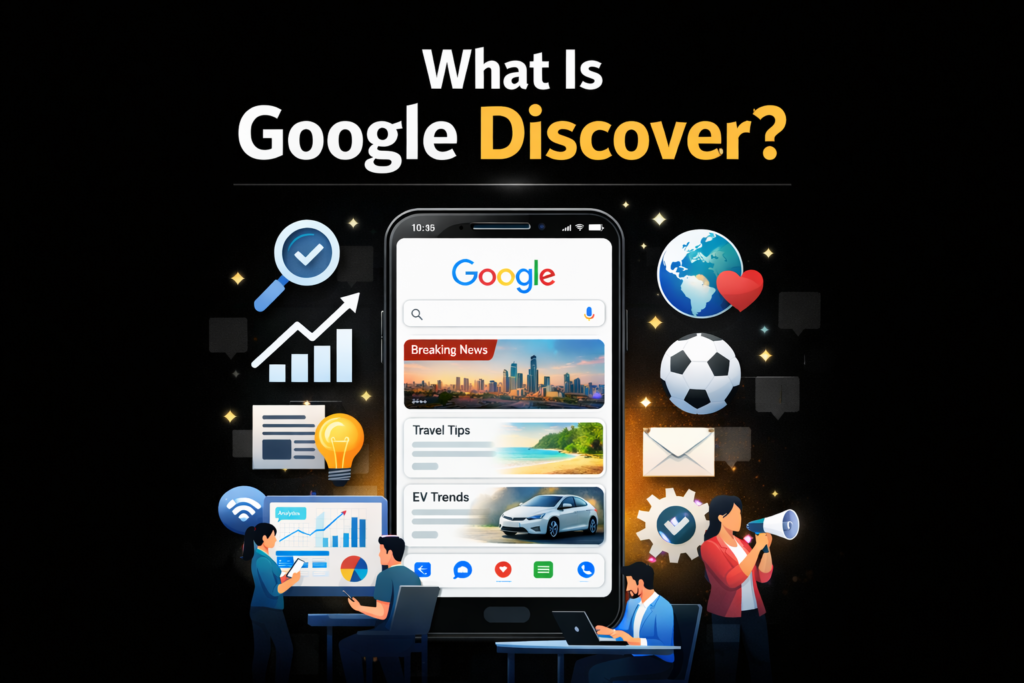
Google Discover is a personalised content feed that appears across several Google properties on mobile devices, including:
Instead of waiting for someone to type a search into Google, Discover shows content to users based on what they are already interested in. It looks at what they search for, read and engage with, then suggests content that is similar to this. This means that visibility is based on your users’ interests rather than specific keywords.
For publishers and brands, Discover provides an opportunity to reach users passively, expanding visibility beyond traditional keyword targeting.
You’re no longer relying on users coming to you, now your content can find them.
Traditional search is query-driven. A user enters a keyword and Google returns the most relevant results.
Discover works differently in that it predicts what users are likely to engage with and surfaces content accordingly. It relies heavily on entity recognition, behavioural signals, topical authority and engagement metrics.
Ranking in Google doesn’t automatically translate to visibility in Discover, and getting featured here requires you to consider more than just keyword targeting.
Google Discover introduces an entirely new perspective on driving organic traffic to your site. For brands with large content teams publishing fresh content at scale, Discover can be a way to drive organic traffic passively without active search intent.
If you can get your content featured in Google Discover consistently, it gives your team more flexibility and creative freedom when it comes to writing fresh content.
Previously, organic content strategies have often been limited to strict and rigid keyword targeted articles that are almost formulaic in nature.
A lot of this is driven by the skyscraper approach to SEO content writing, which was a popular and effective methodology for years. This technique has since been less effective with the rise of AI. Large volumes of low-quality ‘skyscraper’ content can now be produced quickly, creating a quality control nightmare for Google.
As a result, fresh insights, original thinking, and unique points of view are now far more important if you want your content to cut through.
Discover opens up a new channel where thought leadership content and more ambitious pieces can gain organic traction alongside distribution via mailing lists, social media and more.
Eligibility for Google Discover is automatic – there’s no submission or manual approval process you need to go through. It works very similarly to traditional organic search indexing, with some nuance.
If your content is crawlable, indexable, and meets Google’s policies, it can appear. However, just because your content is ‘eligible’, it doesn’t mean that it will be served to target users. Visibility is determined algorithmically based on a few rules, with some being slightly different to what SEOs will be used to paying close attention to.
Learn more about crawlability and indexability in SEO.
As above, your content must be crawlable and indexable. Pages blocked by noindex tags, robots.txt rules, or technical errors can’t appear in Discover. Strong technical SEO foundations are just as important here as with any traditional organic strategy.
Content must align with Google Discover and Google News content policies. Misleading, exaggerated or sensational previews reduce eligibility.
For more information, read the full list of Discover content policies.
Discover is a mobile-first feed, so pages must load quickly and render properly on mobile devices, avoiding intrusive interstitials and pop-ups.
All content must be served securely via HTTPS. Google requires this for Discover inclusion.
Beyond basic eligibility, several signals influence how often content appears.
Original, informative and well-structured content performs best. Articles should demonstrate expertise, clarity and purpose. Thin or derivative content is unlikely to gain any traction.
Engagement signals, such as click-through rate, dwell time, scrolls and return visits, are believed to influence how likely your content is to be pushed consistently by the Discover algorithm.
If users consistently engage with your content, similar articles are more likely to be surfaced.
Discover relies on Google’s understanding of entities. Put simply, entities are the specific things Google can clearly identify and define, such as people, brands, sports teams, events, products, places, or even broader concepts like “electric vehicles” or “remote working” for example.
Rather than just matching keywords, Google tries to understand what your content is actually about and how it connects to real-world topics. It builds a knowledge graph of these entities and the relationships between them.
Clear entity signals in your content help Google confidently recognise who or what you are talking about. This makes it easier for Google to associate your articles with users who follow, search for, or regularly engage with those topics in Discover, boosting the chances of having your content served to them.
Timeliness and alignment with current interests improve the likelihood of inclusion. By planning content thoughtfully with consideration to what’s topical, you’re more likely to have success in Discover.
In many ways, this is similar to Google News. However, this doesn’t mean only new content can appear in Discover.
Evergreen content can resurface at any time in Discover feeds if it aligns with user behaviour and topicality. This can be another huge advantage of having a strong presence in Discover – older content is able to work for you continuously.
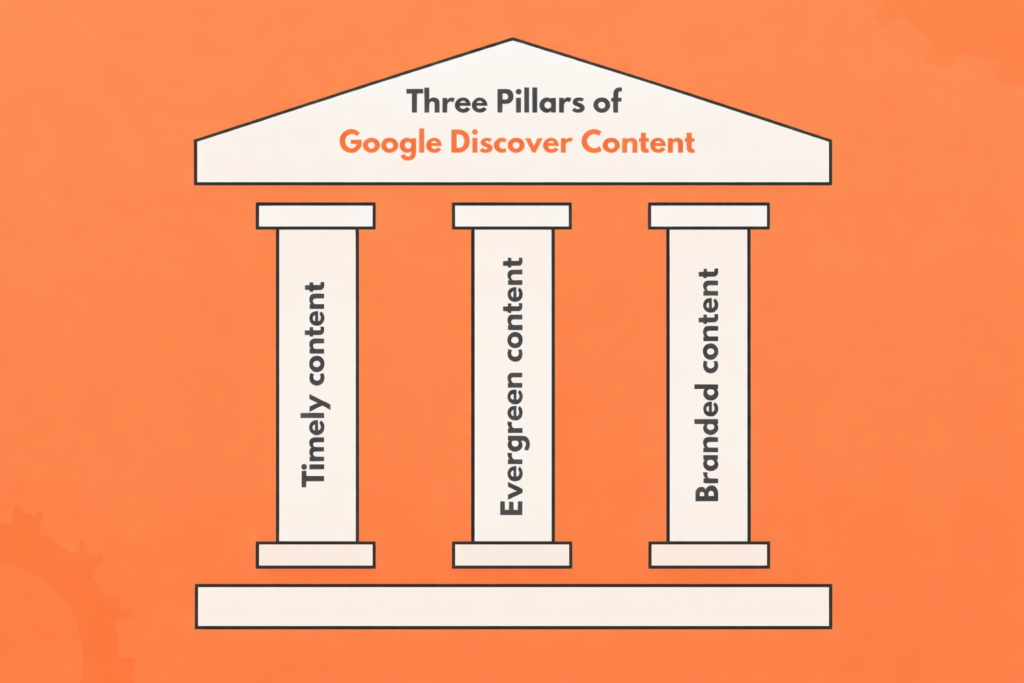
To build sustainable visibility in Discover, your content strategy should be deliberate and planned thoughtfully around what Google wants to see on the platform. We’ve put together a three-pillar framework to break this down clearly.
How much you lean into each pillar can depend on your brand goals, but all three content types have a strong track record of performing well in Discover.
Discover often surfaces content connected to live events, breaking developments or trending discussions.
Timeliness increases the likelihood of being shown to users who are actively engaging with a topic. Clear publish dates and update timestamps help Google understand freshness signals.
For organizations with seasonal peaks, event coverage and announcement-led content can drive significant short-term Discover exposure.
Evergreen content stays relevant long after it goes live and can resurface in Discover as audience interests evolve.
Guides, explainers, detailed thought leadership pieces and other informational content formats not only support long-term SEO performance but can also regain visibility in Discover when they connect naturally to current conversations or align with industry developments.
This makes evergreen content a critical part of your content strategy.
Articles that focus on people, culture, or behind-the-scenes perspectives can drive higher engagement metrics, particularly with users who are familiar with and/or support your brand.
If your brand has a passionate following or a strong existing audience, this kind of content can reinforce familiarity and improve overall engagement metrics, which may support wider Discover performance.
Google’s Discover policies prohibit misleading preview content, exaggerated claims and sensational headlines that misrepresent the article itself.
Headlines and images must accurately reflect the substance of the page. If a preview promises information that the article does not meaningfully deliver, your eligibility may be reduced.
As a platform, Discover doesn’t reward any kind of clickbait tactic. It favours content that delivers value and unique insight aligned with user interests, and editorial standards should prioritise this over anything else.
Having a strong editorial strategy to grow visibility in Discover is only half the battle.
Technical SEO foundations are as important as ever when it comes to organic, and if your setup doesn’t comply with Google’s guidelines for Discover, it is unlikely to surface consistently in feeds.
At a fundamental level, your pages must be crawlable and indexable. This may sound obvious, but it’s an important point to cover first.
There’s also the matter of RSS feeds with Discover, but we’ll cover those a little later on.
Google Search Console is a great tool to assess Discover performance, as we’ll go on to discuss, but it’s also great for troubleshooting any issues with indexation.
The URL Inspection tool can confirm index status, canonical selection and mobile usability. If a page is not properly indexed, it will not be surfaced in Discover.
Discover feeds are highly visual, and listings must include large, compelling images to be eligible for visibility and to increase click-through rates.
Google recommends images at least 1200px wide and the use of the max-image-preview: large setting.
Without this, content may be restricted to smaller thumbnail previews, which significantly reduces click-through rate potential and offers a poor user experience.
Images should also be high-resolution and free from any overlays or watermarks.
The following code sets the maximum size of an image preview in search results:
<meta name=”robots” content=”max-image-preview:large”>
As a meta tag, it should be added to the <head> section of the content.
For publishers operating at scale, image requirements should be embedded within editorial guidelines. Writers and editors should understand minimum sizing requirements, cropping considerations and the importance of selecting the right imagery to complement the content.
Structured data does not guarantee inclusion in Discover, but it improves Google’s understanding of your content and publisher identity.
News or Article schema helps clarify content type, publication date and author details. The Article schema should be in the HTML of each piece of published content.
Organization or Publisher schema reinforces brand identity and ownership signals across your site. This should be added to your homepage.
Validation tools, such as Schema Markup Validator, should be used to ensure schema is implemented correctly and without errors.
Discover is primarily accessed on mobile devices, and as a result, strong performance on mobile is important for getting your content surfaced in feeds.
Pages must load quickly, maintain layout stability and avoid intrusive pop-ups. A slow-loading or visually unstable page offers a poor user experience, which can reduce engagement, and engagement signals play a role in how frequently similar content is surfaced to users.
Core Web Vitals provide useful performance benchmarks. However, optimization should focus on real user experience rather than focusing too heavily on Page Speed Insights scores. If a page feels responsive, loads efficiently and is easy to interact with, it is likely to meet Google’s expectations.
While Google Discover does not require manual submission, RSS feeds can still play an important supporting role in visibility.
Google allows users to “Follow” websites directly within the Google App. When a user follows a site, Google may use that site’s RSS or Atom feed to surface new content from that publisher within the user’s Discover feed.
Again, this doesn’t necessarily guarantee that your content will be served to the user, however it’s a very strong signal if other factors align with Google’s guidelines.
For larger publishers, separate feeds for key sections such as news, blog content or regional subfolders can help structure content more clearly.
E-E-A-T (Expertise, Experience, Authoritativeness, Trustworthiness) should always be a focus with any organic search strategy, and this is no different with Discover.
Being able to demonstrate and show evidence of your knowledge, experience, and credentials will only support your efforts to get content on Discover.
Google Discover surfaces content proactively, and this increases the responsibility placed on publishers to ensure accuracy, credibility and clarity.
A direct quote from Google: “Visitors to your site want to trust and understand who writes and publishes the content they read”.
With this, you should ensure that the appropriate trust signals are in place across your content templates and overall site.
For authoritative niches especially, demonstrating subject-matter expertise can influence how confidently Google surfaces content within Discover feeds.
Visible author bylines can be a useful way to show that your content was written by an expert, with the experience and qualifications to back up their content.
Where possible, these should link to detailed author profiles outlining credentials, background and areas of specialism.
The inclusion of clear publication and update dates reinforces transparency, particularly for time-sensitive topics.
Publisher information should also be easy to find. This includes company details, contact information and any relevant accreditation or regulatory status.
Once you’ve set your strategy in place for increasing visibility in Discover, you’ll want to be able to report on performance. To do this, we suggest using Google Search Console.
Performance data for Discover is available within Google Search Console, and you can navigate to this section via the left sidebar.
With GSC, you are able to see all the familiar metrics you’d expect to see here, but applied to the visibility your site has within Discover.
One of the defining characteristics of Discover traffic is volatility. Traffic can spike significantly over a short period and then decline just as quickly.
These fluctuations are typically linked to changes in user interests, topical relevance, or algorithmic adjustments, and this is completely natural to be seen.
Discover should not be treated as a stable baseline traffic source. Instead, it is considered an incremental growth channel, where visibility can be amplified when content is featured in Discover feeds.
When analyzing performance, it’s best to look beyond the raw traffic figures. Identify patterns in high-performing pieces and reflect on why they may have performed well.
Over time, these factors can inform a more refined Discover strategy.
To summarise, here are some of the most common mistakes that can significantly impact your ability to get content featured on Discover.
It’s important to note that Discover doesn’t benefit every business or organization the same way.
It’s very context dependent, and tends to favor publishers with regular content output, organizations covering timely topics and brands operating in sectors such as news, sport, entertainment or ecommerce with strong editorial support.
Businesses that publish infrequently or rely mainly on relatively static brochure-style sites may see limited visibility.
However, for brands already investing in content production, Discover represents a very meaningful opportunity to scale, grow and get more eyes on the site.
When aligned with technical best practice and strong editorial standards, the platform can drive additional traffic, reinforce brand authority and extend reach beyond keyword-driven search.
Google Discover should be approached as an opportunity to capitalize on and a channel to exist alongside traditional SEO strategies and content marketing. When aligned, the overall impact can be massive.
Do you want to get more from your content strategy? Perhaps you’re exploring Google Discover as a channel to increase your visibility?
At The SEO Works, we combine manual website audits, reviews of your content strategy, and comprehensive reporting to help brands like yours strengthen their presence across organic search.
Speak to our team today, get a free SEO audit, and discuss how we can help accelerate your digital growth.